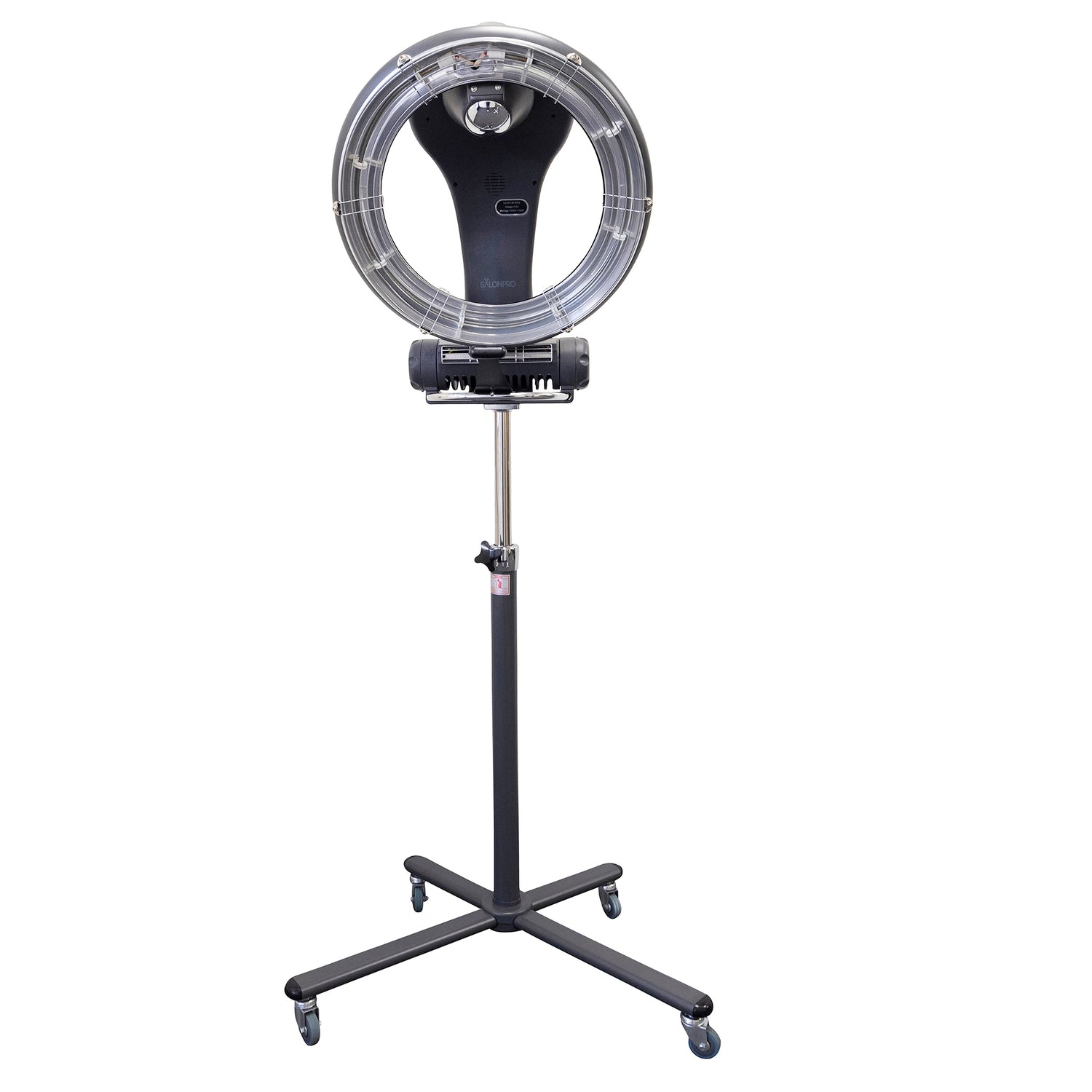



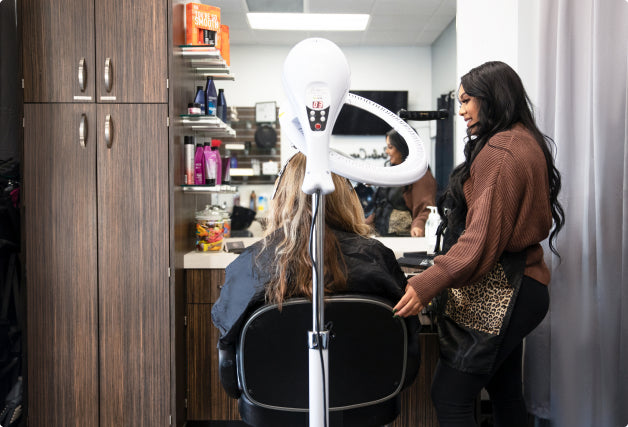









If you have ever watched a client sit under a hood dryer for half an hour while your next appointment waits in the lobby, you have probably wondered whether there is a faster way. There is. So, how does a hair color processor work? In short, it surrounds the hair with gentle, even infrared heat that warms the color or treatment you applied, so it processes faster than it would at room temperature. With a SalonPro infrared processor, that can mean cutting color processing from 30–60 minutes to 10–15 minutes.
Below, we break down what is happening inside the machine, what each setting does, how infrared compares to other kinds of salon heat, and how to get the most out of a processor during a busy day.
What Is a Hair Color Processor?
A hair color processor (also called a color accelerator or infrared hair dryer) is a piece of salon equipment that sits around or above the client's head and applies controlled heat to the hair. Stylists use it to speed up:
- Permanent and demi-permanent color
- Lightener and highlight services
- Conditioning and deep treatments
- Perms and other chemical services
- Drying, including setting styles
Unlike a hand-held blow dryer, a processor works hands-free. Once you set the time and temperature, you can step away to mix the next formula, rinse another client, or greet a walk-in.
How Does a Hair Color Processor Work, Step by Step?
1. Infrared heaters produce warmth
Infrared is a type of heat you already know: it is the warmth you feel from the sun or from a warm stone, even when the air around you is cool. An infrared processor uses heating elements that give off this kind of heat and aim it at the hair. Because it warms the hair and product directly, it does not need to blast hot air across the client's head to do its job.

2. Heat speeds up the color or treatment
Hair color, lightener and many treatments are chemical processes. Like most chemical processes, they generally move faster when they are warm. By holding the hair at a steady, comfortable temperature, a processor helps the product finish its work sooner. That is why so many colorists treat their processor as a timing tool, not just a dryer.
Pro tip: always follow the color or lightener manufacturer's directions for using heat. Some formulas are made for heat; others are not. Your processor gives you the control, and the product label tells you how to use it.
3. Rotation or multiple zones spread the heat evenly
Even heat is what keeps results consistent from root to ends and from one side of the head to the other. Processors handle this in two main ways:
- A rotating heat ring. The SalonPro Orbiting Halo uses a rotating infrared ring that circles the head for even coverage. You can also pause the rotation to focus heat on one section, which is handy for a stubborn area or a targeted highlight.
- Multiple heat zones. The SalonPro Multi-Zone+ has 5 independently controlled infrared heaters, each with a built-in fan, so you can adjust different areas of the head separately.
4. Digital controls keep every service repeatable
Modern processors let you set time, temperature, fan and (on rotating models) rotation from a digital panel. The Orbiting Halo and Orbiting Halo 2.0 also include 5 preset service modes, so you can choose a setting for the service and start the timer in seconds. Once you find the settings that work for your favorite formulas, you can repeat them client after client.
Infrared Processor vs. Other Salon Heat
Most salons already own a hood dryer or a few blow dryers. Here is how they compare when it comes to processing color.
| Heat source | How it heats | Hands-free? | Best for |
|---|---|---|---|
| Infrared color processor | Infrared heat aimed at the hair, spread by rotation or zones | Yes | Speeding up color, lightener and treatments; drying |
| Hood dryer | Heated air inside an enclosed hood | Yes | Roller sets and traditional drying |
| Hand-held blow dryer | Fast stream of heated air | No | Blowouts and styling |
| No heat (room temperature) | None | Yes | Formulas that should not be used with heat |
Want a deeper side-by-side? Read our guide to infrared hair color processors vs. hooded dryers.

Why Faster Processing Matters for Your Salon
Time is the one thing a stylist can never make more of. When color processes in 10–15 minutes instead of 30–60, a few good things happen:
- Your book opens up. Shorter processing can free up room for another client, a quick add-on service, or a longer lunch.
- Clients spend less time waiting. Busy clients appreciate getting in and out faster, and a shorter visit is easier to fit into their week.
- Your day runs on schedule. A steady, timed processor makes it easier to plan double-booked color clients without the whole afternoon running late.
Curious what that extra time could be worth? Try our salon earnings calculator and plug in your own numbers.
How to Use a Hair Color Processor: Best Practices
- Read the product label first. Confirm the color, lightener or treatment can be used with heat, and note any time or temperature guidance.
- Position the processor evenly. Adjust the height so the ring or heat zones sit evenly around the head, not tilted toward one side.
- Start with your go-to settings, then fine-tune. Use a preset mode for the service if your model has one, then adjust temperature, fan or rotation if needed.
- Check in on your client. Ask if they are comfortable and adjust the temperature if they feel too warm.
- Check the hair, not just the timer. Do a strand test before rinsing, just as you would without heat.
- Keep notes. Write down the settings and time that worked for each client's formula so the next visit is even faster.
For more ideas, see our tips on getting the most efficiency and profit from a hair color processor.
Choosing the Right Processor for Your Space
The right model depends on how your salon is set up and how many color clients you see.
- Rolling base: moves from station to station on caster wheels and adjusts in height. Great if several stylists share one or two processors. The Orbiting Halo Rolling Base and the Orbiting Halo 2.0 are both built this way.
- Wall mount: saves floor space in tight salons and suites, with a swing arm that moves the head into place. Wall-mounted models must be installed by a licensed and bonded contractor.
- Rotating ring vs. multi-zone: a rotating ring gives simple, even coverage with one set of controls; multi-zone gives you separate control over different areas of the head.
Not sure which one fits? Our SalonPro processor comparison walks through every model, or you can browse all infrared hair dryers and color processors.
Frequently Asked Questions
Does a hair color processor damage hair?
A processor applies controlled, adjustable heat, so you stay in charge of the temperature and time. Use settings that match the product you applied, follow the manufacturer's directions, and check in with your client during the service.
Can I use a color processor with any hair color?
Not always. Many color lines and lighteners can be used with heat, but some are designed to process at room temperature. Always check the product label before using any heat source.
How long does color take under an infrared processor?
With a SalonPro infrared processor, color processing can be cut from 30–60 minutes to 10–15 minutes. The exact time depends on the product, the service and the client's hair, so always do a strand test.
Can a color processor also dry hair?
Yes. SalonPro processors work as infrared hair dryers too, so the same machine can speed up color, treatments and drying.
Do I need special wiring to use one?
The Orbiting Halo, Orbiting Halo 2.0 and Multi-Zone+ rolling models run on standard 110V power and plug into a regular 3-prong US outlet with a 6 ft cord. Wall-mounted models also need professional installation on a suitable wall.
The Bottom Line
A hair color processor works by wrapping the hair in even, adjustable infrared heat so color and treatments finish faster, while you stay free to work on other clients. For a busy colorist, that time adds up quickly. Join the 40,000+ salon pros who trust SalonPro, and shop our infrared hair dryers and color processors to find the right fit for your salon.